
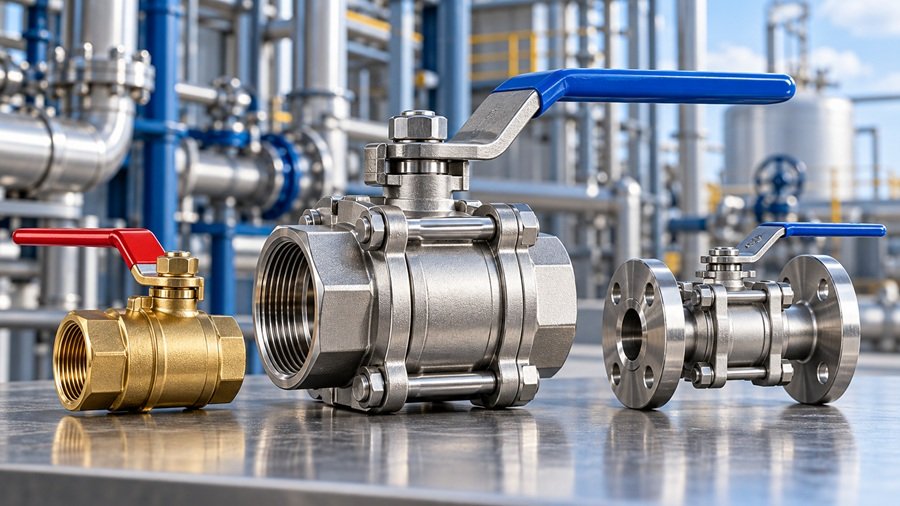
A ball valve is a valve that turns only a quarter turn. The ball inside the ball valve has a hole that lets liquid or gas pass. When the hole lines up with the pipe the ball valve allows fluid to flow. When the ball valve is turned so that the hole is not in line the ball valve stops the flow.
Ball valves are found in plumbing, water treatment systems, manufacturing plants and industrial piping. The ball valve is easy to use. The ball valve works well whenever a system needs an opening and closing.
However selecting a ball valve is more than matching the ball valve size to a pipe. The ball valve pressure rating, the ball valve temperature range the ball valve compatibility the ball valve seat material and the ball valve connection type all decide whether the ball valve is suitable.
This guide explains how ball valves work. This guide shows the differences between common ball valve designs. This guide lists the factors that matter when a person chooses a ball valve.
What Is a Ball Valve?
A ball valve uses a closure element to open or block a flow passage. The ball inside the ball valve sits in the ball valve body. The ball connects to a stem. The stem is moved by a handle, a gearbox or a powered actuator.
Standard two‑way ball valves move from fully open to fully closed by turning 90 degrees.
In manual ball valve designs a handle that is parallel to the pipe shows that the ball valve is open. A handle that is perpendicular shows that the ball valve is closed. Always check the manufacturer’s position markings because handle arrangements can differ.
Ball valves are commonly used for isolation. Isolation means that the ball valve separates a section of a system from the flowing fluid.
How Does a Ball Valve Work?
Open Position
When the passage inside the ball lines up with the inlet and outlet fluid flows through the ball valve.
The restriction depends on the ball valve bore size and internal design. A full‑bore ball valve usually creates restriction than a similar reduced‑bore ball valve.
Closed Position
Turning the handle rotates the ball so the ball’s solid surface blocks the passage. The ball valve seats contact the ball. Create the sealing surfaces.
The quality of shutoff depends on the ball valve design the condition of the seats the operating conditions and the ball valve compatibility with the fluid.
Partially Open Position
A rotated ball leaves a smaller flow opening. Though this restricts flow a standard isolation ball valve is not automatically suitable for long‑term throttling.
For flow regulation use a ball valve that is specifically designed and sized for that duty. Dedicated ball control ball valves have features intended for controlled operation.
Main Components of a Ball Valve
| Component | Main Function |
|---|---|
| Body | Contains pressure. Houses internal parts |
| Ball | Opens or blocks flow passage |
| Seats | Provide sealing contact around ball |
| Stem | Transfers movement from operator to ball |
| Stem packing or seals | Restrict leakage around stem |
| Handle or actuator | Operates ball valve |
| End connections | Connect ball valve to piping system |
Some ball valve models also include locking handles, position indicators or other protective features. These should be checked in the product documentation.
Types of Ball Valve
Ball valves can be classified by bore size, ball support, body construction and flow configuration. These categories overlap. One ball valve may be a three‑piece, full‑bore, floating ball valve.
Full‑Bore Ball Valve
A full‑bore ball valve also called a full‑port ball valve has a passage that’s about the same size as the connected pipe’s internal diameter. This reduces flow restriction. Is useful where pressure loss matters. Some full‑bore pipeline ball valves also allow cleaning or inspection equipment to pass.
Reduced‑Bore Ball Valve
A reduced‑bore ball valve has an internal passage than the connected pipe. It can give a solution but the smaller opening creates more restriction. Selection should consider the required flow capacity and the acceptable pressure drop.
Floating Ball Valve
In a floating ball valve the ball moves a little inside the seats. Differential pressure pushes the ball toward the seat helping it seal. The operating torque and the suitability of the floating ball valve depend on the ball valve size, the pressure and the seat design.
Trunnion‑Mounted Ball Valve
A trunnion‑mounted ball valve supports the ball mechanically at the top and bottom. The ball valve seats seal around the supported ball. These designs are commonly offered for demanding pipeline and process applications. Full‑bore, reduced‑bore, floating and trunnion ball valve configurations are available, from manufacturers.
Two-Way and Three-Way Designs
I see that a two-way ball valve has an inlet and an outlet and usually controls one flow path.
I notice that a three-way ball valve has three ports and can redirect or combine flow depending on its passage and allowed positions.
I find that common three-way passages include L-port and T-port arrangements. The actual flow paths must be checked against the manufacturer’s diagram; not every three-way ball valve offers every combination.
One-Piece, Two-Piece and Three-Piece Construction
I understand that body construction affects installation, access and maintenance.
| Construction | General Characteristics |
|---|---|
| One-piece | body with limited internal access |
| Two-piece | Body formed from two main sections |
| Three-piece | Central body section connected to two end sections |
A three-piece valve can offer easier access for servicing. In some designs the centre section can be. Swung out while the end connections stay attached.
I realise that serviceability depends on the product. A multi-piece body does not automatically mean that every component is repairable or replaceable.
I see that manufacturers offer three-piece designs with connection and maintenance arrangements.
Common Body Materials
I know that the body material must suit the surrounding environment.
| Material | Typical Considerations |
|---|---|
| Brass | Common in plumbing and general service applications |
| Stainless steel | Used where corrosion resistance and fluid compatibility require it |
| Carbon steel | Used in industrial pressure systems |
| PVC or CPVC | Used in plastic piping within specified limits |
| Special alloys | Selected for particular corrosive or demanding services |
I understand that stainless steel is not resistant to every chemical and plastic valves do not all share the same temperature or pressure capability.
I realise that material selection should account for concentration, temperature, exposure duration and external corrosion.
Seats and Seals
I see that a valve’s body rating alone does not establish its suitability. Seats, packing and seals may impose operating limits.
I know that soft-seat materials can include PTFE-based compounds and other engineered polymers. Different options provide combinations of chemical resistance, temperature capability and mechanical performance.
I find that metal-seated designs are also available for demanding applications but their leakage performance and operating characteristics must be checked individually.
I see that manufacturers provide seat options for specific services. The correct choice requires the valve’s pressure-temperature data and compatibility information.
Where Are Ball Valves Used?
I notice that ball valves serve systems provided the selected model is suitable for the duty.
Water and Plumbing
Ball valves are commonly used to isolate supply lines, equipment and sections of piping.
I understand that for drinking-water systems one must check the required potable-water approvals and applicable local requirements.
Manufacturing and Process Systems
I see that industrial applications include liquid transfer, utility services and equipment isolation.
I realise that chemical service requires verification of all wetted materials, including seats and seals.
Gas and Compressed Air
I notice that suitable models can control gas or compressed-air lines. A valve intended for water service should not be assumed suitable for gas.
Steam and Special Services
I find that steam-rated ball valves are available. Steam suitability must be confirmed for the specific model and conditions. Special services may also require materials, cleaning or construction.
Advantages and Limitations
I understand that the main advantages of a ball valve include operation, compact construction and effective isolation when correctly selected and maintained.
I see that full-bore designs can offer an unrestricted flow path. Manual and powered operating options also make these ball valves adaptable to systems.
I realise that limitations include seat wear, damage from fluids and potentially excessive torque under demanding conditions. Rapid closure in a line can contribute to water hammer.
I understand that standard isolation designs may also perform poorly when used for throttling. Application suitability should take priority over convenience.
How to Choose the Right Ball Valve
I notice that one should start with the operating conditions, than the product’s appearance.
| Selection Factor | What to Check |
|---|---|
| Fluid | compatibility and cleanliness requirements |
| Pressure | Maximum operating pressure and possible surges |
| Temperature | Normal and extreme operating temperatures |
| Flow | Required capacity and acceptable pressure loss |
| Size | Pipe connection size and actual bore |
| Seats and seals | Compatibility and operating limits |
| Connections | Threaded, flanged, welded or other specified ends |
| Operation | Manual, gearbox, pneumatic or electric |
| Service requirements | approvals and special features |
| Maintenance | Access, spare parts and servicing arrangements |
I know that one should read the pressure-temperature curve than treating the maximum pressure marking as valid at every temperature.
If the ball valve is powered check the torque needed the power or air supply available the speed of operation and the position you want after power is lost. The manufacturer says you must also check pressure, temperature and the type of fluid when choosing a ball valve.
Installation and Maintenance Basics
Follow the manufacturer’s instructions for installing the ball valve. Make sure the connections fit before you put the ball valve in place.
Make sure the pipe is supported so the ball valve does not have mechanical pressure. Look for flow‑direction arrows. Leave enough room for the ball valve to turn.
Before you check or service the ball valve shut off the system reduce the pressure drain any fluid and be sure the system is safe. A closed ball valve can keep pressure or fluid inside its chambers.
Look for leaks on the outside of the ball valve any effort to turn it or a weak shutoff. Do not force a handle or change pressurised parts without a proper procedure.
How often you maintain the ball valve depends on the fluid, how often it runs the environment and what the manufacturer says.
FAQs
1. What does a ball valve do?
A ball valve is used to open, close or stop liquid and gas flow in a pipe that fits the ball valve.
2. Is a ball valve good for controlling flow?
Most ball valves only shut the flow. To adjust flow continuously you need a ball valve made for control or throttling.
3. What is the difference between a full‑bore and a reduced‑bore ball valve?
A full‑bore ball valve has a passage that’s almost the same size, as the pipe. A reduced‑bore ball valve has a passage and usually gives more restriction.
4. Can every ball valve handle water or steam?
No. How hot a ball valve can handle depends on its body, seats, seals and the pressure‑temperature rating.
5. Why does a ball valve leak?
A ball valve can leak if its seats are damaged if there is debris if the packing is worn if the materials are wrong or if it is used beyond its limits.
Conclusion
A ball valve gives easy one‑quarter turn shutoff but it works well only if you pick the kind. Check the fluid, pressure, temperature, bore, materials and connections at once. Picking the design and following the install and maintenance steps keeps the ball valve doing its job every time.
